Sunday, June 9, 2013

Working Together

It is amazing how much grass is needed to fill the pit silo. More and more grass is chopped down and carried to the pit. Then because the grass cutting machine is broken machetes are used to chop.

Paul is busy chopping and watching out for chiggers, little mites that bite and leave you itching away. And someone needs to be in the pit to continually pack down the feed so it will not spoil.

Dave is always busy teaching but here he is carrying a load of grass. I added another photo of how the Rwandans pack, tie, load and carry grass.

I heard that farmers from the community have come to help AND learn with them. To learn about this new process of storing grass for the tough times when there is little grass available for their animals. It's not just about the process but about the relationships that are being made.

It's about reaching out to the community and sharing farming techniques that are crucial to helping them succeed as farmers and being able to feed their families.

Friday, June 7, 2013

Rabbits and Chicks

Joanne ~~ The whole crew spent much of Wednesday in the rabbit house using wood and wire to construct new doors on all the rabbit hutches. Nine done and nineteenth go. Joanne even had to hammer with a flat rock as all the hammers were being used.

The while crew worked on this except Dave as he made several trips in the afternoon to fetch tools and supplies, using almost every mode of transportation available car, motorcycle taxi, bicycle taxi and walking. Everything here is an adventure.

The chicken incubator was purchased by St. Paul's last year but was in need of a thermostat. Dave brought one and it is now in operation. They are doing a test batch of 45 fertilized eggs. At full capacity it should hold 100-150 eggs. Instructions were given on it's use and the necessity of rolling the eggs. They hope there will be baby chicks in 21 days.

Finally a reward after days of long hard work. Great coffee and real food at Horeb Coffee.

Digging

Being in missions means doing whatever it takes.

Joanne ~~ The pit silo is almost complete. This was quite a feat as there were huge seams of rocks that they needed to break through. No backhoe, no jackhammer, only five workers with well worn shovels, pry bars and pick axes. A few broken handles later...of course, if you have a straight tree limb,a machetes, a rock, and the skill, you can make a new handle on the spot.

Dave ~~ The pit silo will be three meters in diameter and two meters deep to store 7-8 tons of silage. This will feed two cows for 4 months. The pit can be maintained and used for several years.

How dies it work? Grass will be cut and packed in the silo with someone tamping it to force out the air. When it is full, uncut grass will be put on top and a mound of dirt on top of that. During the dry season the dirt will be removed and the uncut grass. The silage will be sweet smelling and ready to start feeding. It's important that the grass be removed an even depth from the whole face of the silo to prevent spoiling. For easy access the pit is being built is near the barns.

This project will help them feed their animals throughout the dry season when grass is not as plentiful and what is available is very expensive.

The hand crank chopper that Dave worked on in August broke again which meant the grass needed to be chopped by machete. Grass was cut and carried from fields across the property near the Urukundo schools.

The last photo shows how grass is carried in Rwanda.


Thursday, June 6, 2013

A Full Monday

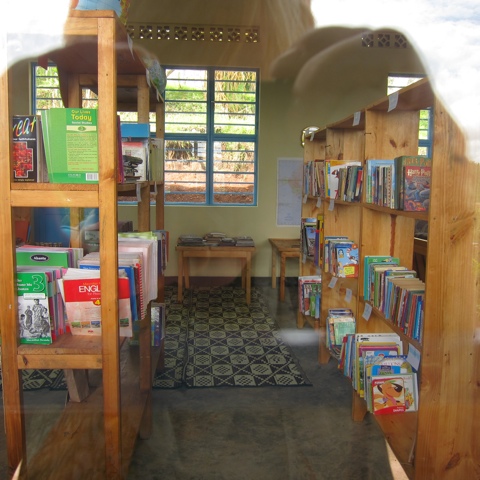
Joanne ~~ Besides visiting the farm and gardens we toured the new school rooms, met one of the teachers and one of Mama Arlene's neighbors who were enjoying the beautiful school library during lunch break. The classrooms are bright and are perched on the hillside with an amazing view of the surrounding hills and valleys. And there are several new classrooms under construction.

Of course we visited with the children who live here. Most of the older kids are away at boarding school, but there are younger ones who are happy to greet visitors with smiles and hugs, and don't seem to mind when we ask them for the 2nd, 3rd or 10th time to tell us heir names.

They don't have a lot of toys, but it is amazing the amount of fun you can have with an empty toilet paper tube or an old water bottle. And they are very happy to know that we are friends of the 2 Carols, Linda and Robin.

After dinner we go to devotions with the kids, and isn't it fun that, halfway around the world, we all know the same words to "Jesus Loves me" and "Oh How I Love Jesus, " (oh, and the Barney song), although we visitors are going to need some work with the verses in Kinyrwanda.

Tomorrow we will begin farm projects!!


Starting

Joanne ~~ Monday was a cool and sunny day at the Urukundo Home. We met with Eugene, the farm manager, and discussed various agricultural projects that we could help with.

But first we checked on the animals - they have many many chickens (layers and broilers), lots of rabbits, one momma pig with 8 piglets, two cows, a calf and two goats. Eugene is very interested in trying to improve the farm and it's fun watch him, Kira and Dave sharing farm ideas even thought the translation is iffy. Especially when they are speaking about terms such as hypocalcemia and carbon (anthrax).

The farming is challenging as all the animal's pens and buildings are built on a steep hillside, resulting in issues with drainage, especially during the wet season, which can lead to illness for the animals. Rwanda is definitely "the land of a thousand hills" as there are few flat fields.

Dave and Paul set up the egg hatching incubator which they will hopefully use to hatch their own chicks. There are only two suppliers of chicks and perhaps Urukundo could be a third.

We checked out the many gardens where beans, peas, corn, carrots, lettuce, cucumbers, potatoes, cassava and lots of cabbage grow.

In the afternoon we took a trip to town to scout out where to buy supplies - there are no hardware stores, but many small stores selling various supplies. It is a food idea to comparison shop.


Wednesday, June 5, 2013

AG Projects

Last time Dave and Kira were in Rwanda they implemented new procedures for feeding the animals, located and purchased fields of grasses, repaired equipment, built mangers and pens and so much more.

With agriculture and livestock reference books they will work with the new Rwandese farm manger, Eugene. He is also a vet.

Projects on their list include:

•Working on the rabbit hutches to improve sanitation to prevent disease.

•Identifying animals with tattoos in their ears and develop record cards for breeding purposes.

•Purchase a male pig that St. Paul's Sunday School class raised money for.

•Possibly build a french drain to resolve the problem of runoff when cleaning the animal pens.

•Build a chicken tiller that will help to prepare the garden for planting. A few chickens will be inside the tiller which can be easily moved from one part of the garden to another. The chickens will also fertilize the ground.

•Dig a pit silo to store forage during the dry season. It will be 3 meters in diameter and 2 meters deep to store 7-8 tons of silage. It will feed two cows for a month. The pit can be maintained and used for several years.

The question is what to start with!
•Off to purchase the pig. Kira in discussions.
•Paul and Dave looking over farm equipment, a grass cutter.
•Dave and Joanne checking out the broilers.


Newest Team

Over the next two weeks I will be sharing news of the newest team from St. Paul's United Methodist Church to arrive and the work being accomplished. I wish I was with them. Dave Howell and Kira Hydock have returned for their second time and Joanne and Paul Steindorf have joined them. The Steindorfs have travelled on short-term medical missions to Nicaragua.

The focus of their work will be agriculture and livestock. Dave a former peace corp volunteer and retired professor of agriculture and Kira a PSU student majoring in veterinary science and international development have a wealth of experience to share. Paul a radiologist and Joanne a community volunteer will be an essential part of this team.

The first day was spent touring Urukundo and learning about their farm, school, sewing center, children's home and meeting the staff.

I know there will be many stories to share over the next 2 weeks.

*The team- Dave, Kira, Paul & Joanne
*Starting their LONG flight to Rwanda
*Claude and his bug
*Kira reconnecting with the kids.